The short answer
The seller markets a 22-ingredient vision-support formula and arranges its ingredient descriptions into four groups. Counting the individually named ingredients on its current promotional page yields 21 distinct names. Only zinc (11 mg) has a clear numerical amount in the visible sales-page ingredient text we reviewed. A complete, authenticated current Supplement Facts panel is needed to resolve exact amounts, blend details and the counting difference. Seller's list.
Do not confuse a named ingredient with a clinically meaningful dose. Some third-party sites reproduce a Supplement Facts image and report seven individual vitamin/mineral amounts plus a 351 mg proprietary blend; we have not treated that transcription as independently authenticated primary label evidence.
Seller-listed ingredient map
| Seller group | Names shown | What the listing establishes |
|---|---|---|
| Vision Defense Matrix | Astaxanthin, vitamin C, vitamin E, copper, selenium, chromium | Named ingredients; individual amounts not shown in sales-page descriptions |
| Gut-Eye Barrier Complex | Grape seed extract, rutin, quercetin, taurine, alpha-lipoic acid | Named ingredients; quantities not confirmed |
| Vision Performance Boosters | Ginkgo biloba, coleus forskohlii, eyebright | Named botanicals; standardized extracts/doses unconfirmed |
| Macular & Lens Protection | Vitamin A/beta-carotene, lutein, zeaxanthin, zinc, bilberry, lycopene, saffron | Named ingredients; zinc publicly described as 11 mg |
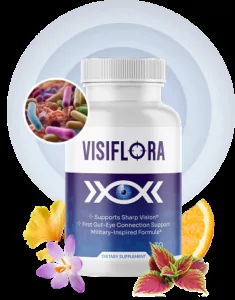 Reference bottle
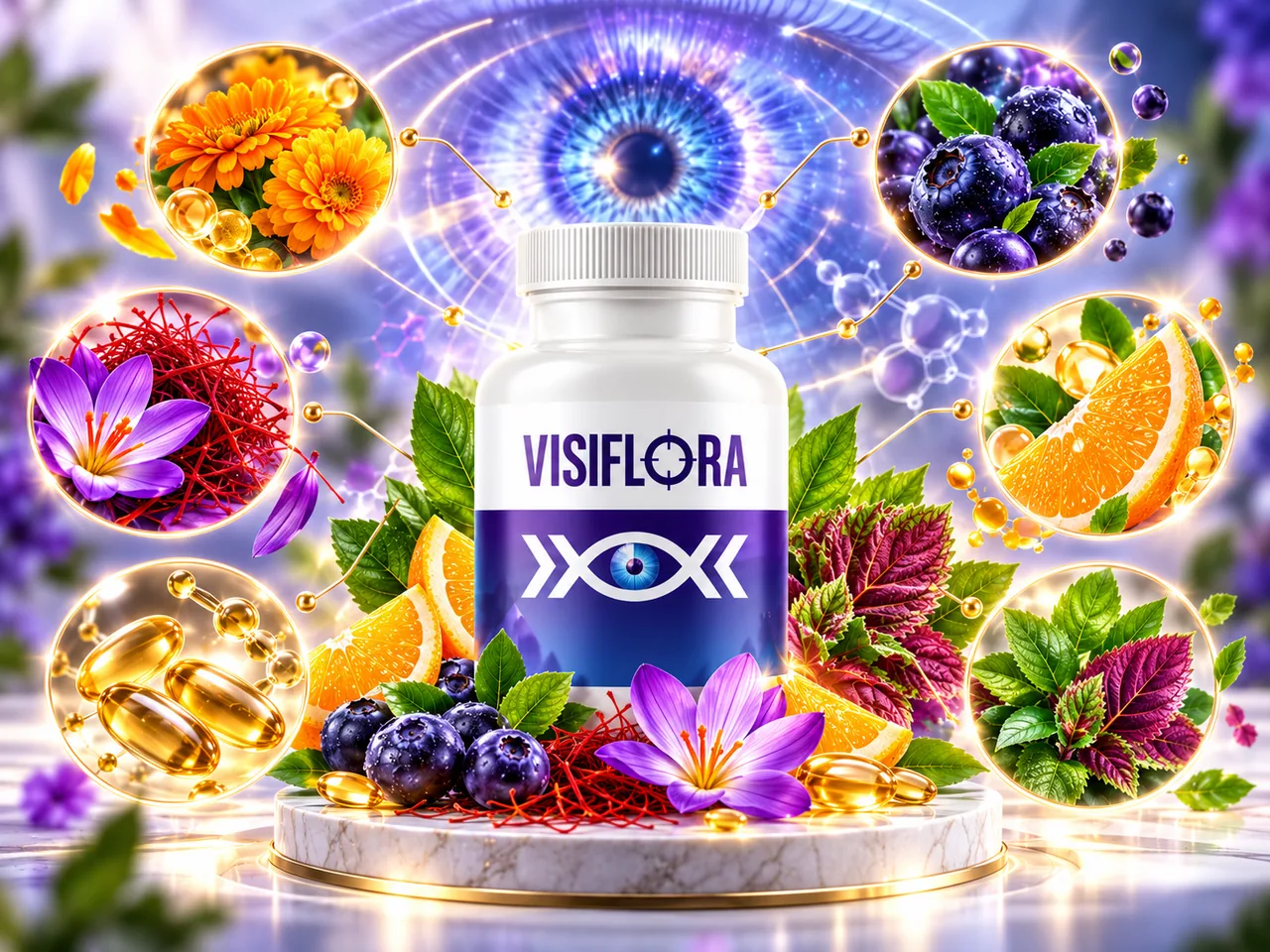 Formula overview
Related visual gallery
These additional visuals are included on this page to make the review easier to follow and more engaging for readers.
All visuals on this website are original editorial illustrations or reference imagery added to improve readability. They are not medical proof, testimonials or guarantees of results.
Each of these names is taken from the seller's public ingredient overview. Exact forms, amounts and any differences between batches should be checked against the bottle label received.
Ingredients with relevant eye-nutrition context
Lutein and zeaxanthin
These carotenoids feature prominently in the AREDS2 research—but the National Eye Institute's trials used a defined combination containing 10 mg lutein and 2 mg zeaxanthin alongside other specified nutrients. VisiFlora's sales-page text names both but does not disclose their quantities. The presence of those words is therefore not proof of AREDS2 equivalence. National Eye Institute.
Zinc and antioxidant vitamins
The seller publicly specifies 11 mg of zinc. By comparison, the NEI's described AREDS2 formula has 80 mg zinc. These are different formulations with different intended evidence bases. More zinc is not automatically preferable, and people should not attempt to recreate a clinical formula without medical guidance. Vitamins C and E, copper and selenium are mentioned by the seller, but their promotional-page doses are not clearly established. Seller · NEI.
Bilberry
Bilberry has a long eye-health marketing history, including claims related to night vision. The US National Center for Complementary and Integrative Health (NCCIH) reports that rigorous research has not established better night vision in healthy people, and the research overall does not clearly show a benefit for any health condition. Dose and extract standardization still matter. NCCIH.
Ginkgo biloba
Ginkgo is studied for many uses, but research results cannot be automatically carried over to visual acuity or to a complex finished capsule. Importantly, ginkgo can interact with medicines, including anticoagulants. NCCIH.
Vitamin A as beta-carotene
Vitamin A is involved in normal vision. But supplemental beta-carotene has important context: large-dose trials in current/former smokers identified increased lung-cancer risk. The VisiFlora seller names beta-carotene without a precise dose in the promotional text; the evidence does not let us estimate VisiFlora-specific risk from those different trials. NIH Office of Dietary Supplements.
Saffron, taurine, quercetin, rutin and other extracts
These ingredients can be investigated through individual biochemical or small clinical studies, yet each requires a verified form, tested dose, population and outcome to draw a useful conclusion. Without those particulars, phrases like “scientifically proven formula” would overstate the evidence. Our evidence review explains this separation.
Why the label-disclosure gap changes a review
An ingredient list answers what might be present. It does not reliably answer how much is present, what quality or standardization it has, how it was tested or whether those components improve symptoms in this formulation. To compare with clinical studies, look for an accurate Supplement Facts photo covering serving size, individual doses, any proprietary blend, manufacturer/distributor and other ingredients.
What to check on the bottle before using it
- Confirm the serving size and the current, dated panel, rather than relying on a copied webpage.
- Look for lutein, zeaxanthin, saffron, ginkgo and bilberry amounts—not just their names.
- Review beta-carotene form and quantity, especially if you smoke or previously smoked.
- Bring the label and full medication list to your pharmacist or eye specialist if you have any health condition.
- Check that lot, seller and return information match the order documents.
Ingredient review verdict
VisiFlora publicly identifies many ingredients, but the specific label transparency needed to support stronger efficacy conclusions remains incomplete in sources we could authenticate. The sensible next steps are to consult the safety review and compare published research against the actual AREDS2 formulation.