Direct answer
Clinical effectiveness of the exact VisiFlora finished formula has not been independently established in the sources we could verify. The seller describes a multi-ingredient eye-health supplement and a “gut-eye” nutritional idea. That marketing narrative should be distinguished from studies testing a specific formulation against measurable outcomes. Seller.
This does not prove the capsule is ineffective. It means a buyer should not assume it improves visual acuity, removes floaters, reverses eye disease or replaces prescribed care. We did not personally test the product, collect participant outcomes or commission laboratory testing.
A useful hierarchy of evidence
| Evidence level | What it could tell us | Status for this review |
|---|---|---|
| Randomized trial of the marketed VisiFlora formula | Whether this specific product improves a predefined endpoint | Not independently located/verified |
| Trial of an identical formula and dose | Some more direct relevance, if comparable | Not independently verified |
| Research on a named ingredient at a specified dose | Possible effects of that ingredient under study conditions | Available for certain nutrients, not product-wide proof |
| Laboratory or theoretical “gut-eye” mechanism | Biological plausibility or a hypothesis | Does not prove meaningful human outcomes |
| Seller anecdotes and advertising | What is claimed or reported by seller | Not independent clinical evidence |
 Evidence snapshot
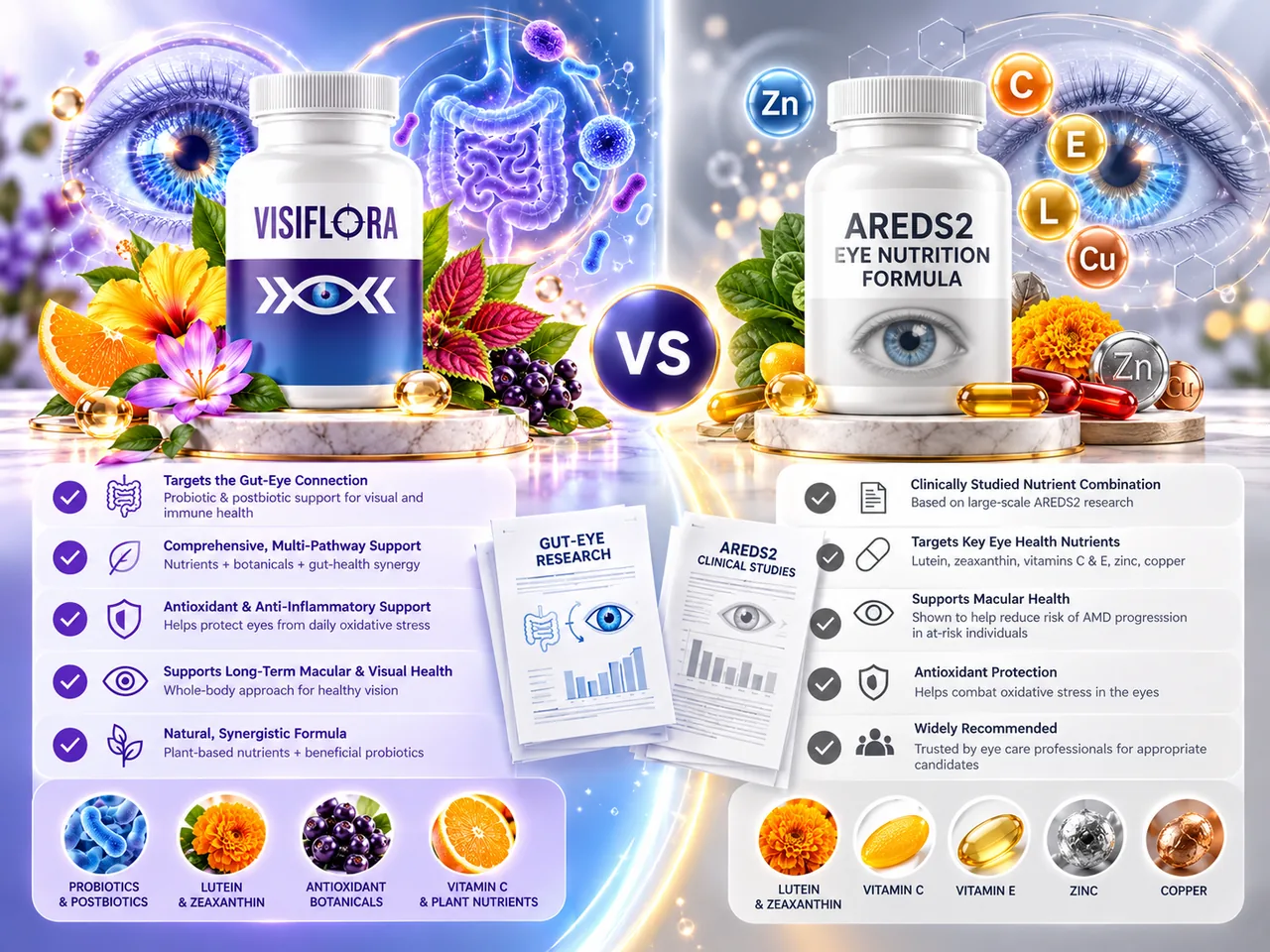 Comparison context
Related visual gallery
These additional visuals are included on this page to make the review easier to follow and more engaging for readers.
All visuals on this website are original editorial illustrations or reference imagery added to improve readability. They are not medical proof, testimonials or guarantees of results.
What about AREDS2 research?
The strongest well-known eye-supplement trials concern AREDS/AREDS2, created for particular stages of age-related macular degeneration (AMD). The National Eye Institute says AREDS2 formulations may slow progression for people with intermediate AMD and for some patients with late AMD in one eye. They are not established as universal vision enhancers. NEI AREDS2 guidance.
Crucially, VisiFlora lists a different range of ingredients and a visible zinc amount of 11 mg compared with 80 mg in the NEI reference formula. The exact quantities of lutein and zeaxanthin are not confirmed on the seller's public ingredient overview. It would therefore be unsound to claim that the AREDS2 findings validate VisiFlora. Comparison.
What about the gut-eye theory?
Nutrition, systemic inflammation and eye health can be related. But a broad biological mechanism is several evidentiary steps away from showing that a particular capsule changes eye outcomes. A reliable clinical demonstration would require a clearly defined formula, an appropriate comparison group, meaningful outcomes, duration, independent assessment and adverse-event reporting.
Because the seller describes the product as a 22-ingredient system while 21 distinct names appear across its listed groups, we first need an authenticated bottle label before even comparing the complete formulation against outside literature. A plausible scientific story is not itself a clinical trial. Ingredients review.
Can it clear floaters or restore failing vision?
We found no reliable VisiFlora-specific clinical evidence to support such outcomes. Eye floaters, sudden flashes, changes in peripheral vision and other symptoms can have different medical causes. Sudden new floaters, flashes or a curtain-shaped shadow warrant urgent assessment for a retinal tear or detachment. NEI floaters.
For routine visual discomfort, a person may benefit more from identifying the cause: uncorrected refractive error, screen-related dryness, medication effects or an eye condition. An eye exam helps distinguish those problems; a supplement label cannot.
What proof would change this assessment?
We would evaluate a publicly available trial or clinical study protocol of the finished product reporting the exact formula, funding, sample size, inclusion criteria, prespecified visual endpoints, adverse events and results. Independent replication and review would be more persuasive than an unpublished sales claim. A current full Supplement Facts label and transparent quality testing would improve formula assessment, but would not substitute for an efficacy trial.
Evidence review verdict
Ingredient plausibility: some. Verified finished-product efficacy: insufficient. Buyers should treat the product as a marketed supplement, not as an established treatment or AREDS2 replacement. Evaluate the ingredient quantities, safety profile and alternatives together rather than reading any one marketing claim in isolation.